The aim of retirement planning is to have
regular income even after requirement and be financially independent. Apart
from income for household expenses you also need to income for insurance
premium, contingencies, etc. If you also have other goals such as children’s
higher education, marriage, your dream home or dream vacation among others,
then you will need a higher corpus to accommodate these dreams.
Retirement planning should start when you
are young and not when you are nearing retirement. This ensures that you have
enough funds for your various goals. If you start late you will not have enough
savings and you will not be able to meet all your goals. To plan your
retirement income you should follow the steps given below-
1)
Determine your goal- You can start by noting down
various goals you want to achieve post retirement. This may include household
expenses, medical expenses or any other expenses. Also, decide if you will be
working post retirement and if you will have any source of income.
2)
Determine the money you will need annually- End of
work-life does not mean end of expenses. You will have to determine what will
be the minimum amount you will need monthly/yearly. Your retirement age, life
expectancy and the various retirement goals will help you decide how much money
you will need annually post retirement.
3)
Keep inflation in mind- Inflation rises every year. Therefore, the income
which seems sufficient today will not be so by the time you retire. An average
inflation rate of around 8% can be assumed while determining future income and
expenses.
4)
Decide the money you need to save- Calculate how
much you will need to start saving every month to achieve your retirement
goals. Online calculator for this purpose is available which can assist you in
determining this amount.
5)
Start saving- You should ideally start saving for
retirement when you are young. This will give you a bigger benefit of
compounding and your investment corpus will be bigger. Younger investors can
also afford to invest in riskier investment options that can give higher
returns.
6)
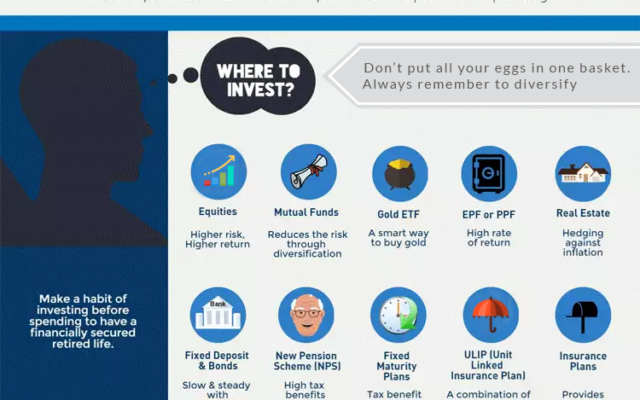
Invest- For your retirement income you can invest
in various schemes such as Public Provident Fund, Employee Provident Fund,
National Pension Scheme, and Senior Citizen Saving Scheme. You can also invest
in mutual funds to achieve your goals. These schemes give better returns as
compared to Bank deposits and also do not carry high risk. You should keep
increasing the investment amount as and when your income increases.
Since retirement income is a long term
goal, there might be some roadblocks in your savings due to changes in personal
or professional situations. There might be changes in your goals along the way.
You can make changes in your investment to suit your needs. However, don’t be
tempted to withdraw your retirement amount before you retire.